
The art of luxury lighting is undergoing a profound refinement.
For decades, luxury interiors pursued abundance—grand chandeliers of monumental scale, brilliantly illuminated ceilings, intricate ornamentation and layers of decorative fixtures competing for visual dominance.
In 2026, the most discerning interiors are embracing a philosophy of restraint and intention.
Drama remains essential. Yet increasingly, that drama emerges through sophisticated contrast: a breathtaking sculptural statement piece paired with refined architectural lighting so expertly integrated it becomes virtually imperceptible.
These are the defining lighting directions shaping the world's most prestigious interiors in 2026.
1. Lighting as Architectural Sculpture
The chandelier has transcended its traditional role as a functional ceiling element.
It has become an architectural statement—a three-dimensional installation that commands presence.
Contemporary luxury lighting merges glass, crystal, precious metals and bespoke suspended elements into forms that blur the distinction between fine art and functional design.
This elevated approach resonates powerfully within:
- Palatial entrance halls
- Multi-story staircase voids
- Double and triple-height gallery spaces
- Soaring atriums
- Expansive living sanctuaries
Rather than filling spatial voids, these installations define and dignify the entire environment.
2. Curated Drama — Restraint as Refinement
True luxury transcends the impulse to adorn every surface.
A singular, exceptional lighting feature often commands far greater visual impact when permitted the space to achieve its full presence.
Consider:
- A monumental chandelier suspended above a formal dining tableau
- A sculptural installation cascading through a soaring stairwell
- A carefully curated collection of designer pendants anchoring a kitchen island
Complementary architectural lighting remains deliberately subtle, allowing the signature piece to breathe and dominate with authority.
3. The Emergence of "Invisible" Luminescence
The most sophisticated lighting design is often imperceptible in its presence.
Recessed architectural profiles, concealed illumination sources, strategically positioned spotlights and integrated ambient lighting orchestrate the space without drawing attention to the technology itself.
Instead, perception focuses upon what light reveals:
The refined texture of marble and stone.
The organic warmth of timber grain.
The geometry of architectural arches.
Curated artwork and collections.
Refined architectural details.
Architecture emerges as the true focal point.
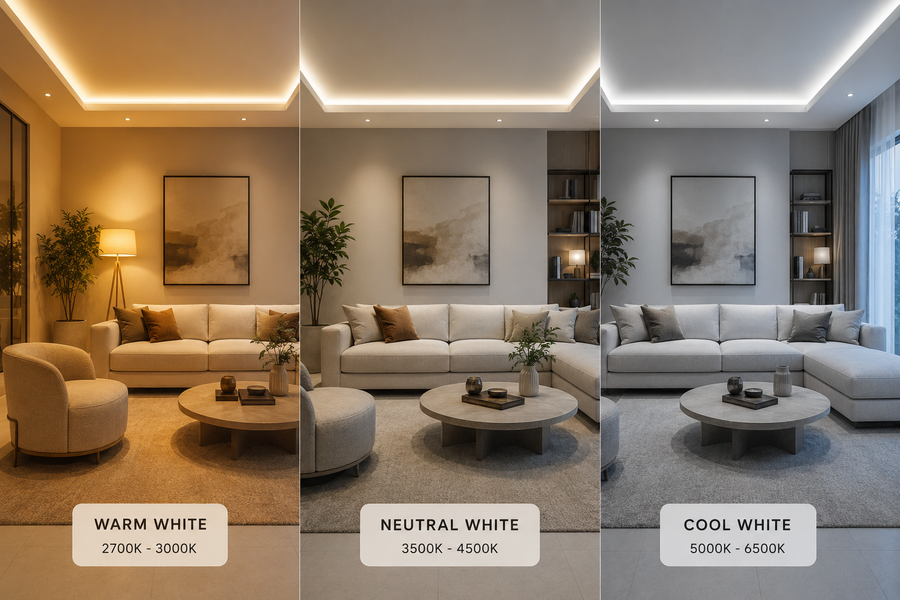
4. The Renaissance of Warm Luminosity
The clinical aesthetic of stark-white interiors bathed in cool light is yielding to environments of warmth and refined hospitality.
Warmer colour temperatures complement natural stone, precious woods, brass, bronze and textured materiality with exceptional elegance.
Yet this is not uniformity across all spaces.
Lighting temperature has evolved into a deliberate design decision, reflecting the aesthetic vision rather than merely technical parameters.
5. Crystal and Glass Reimagined for Contemporary Luxury
Crystal lighting endures—transformed.
It has matured into abstraction.
Rather than adhering to conventional chandelier typologies, contemporary designs deploy individual crystal and glass elements within liberated, curated artistic arrangements.
For instance:
- Clear, transparent glass achieves refined minimalism and ethereal lightness.
- Amber and golden glass infuses spaces with sophisticated warmth.
- Smoked and grey glass introduces depth, dimension and quiet drama.
- Artisanal coloured glass transforms fixtures into bespoke sculptural installations.
Layering distinct finishes within singular installations produces particularly compelling results, especially within custom commissions.
6. Bespoke Design as the Ultimate Expression of Luxury
An exquisite fixture elevates any interior.
Yet a fixture conceived expressly for that singular space achieves something more profound—it becomes inseparable from the architecture.
Significant residences, luxury hotels and prestigious commercial projects frequently contain spaces where standardized dimensions prove insufficient.
A stairwell void may demand unusual vertical extension.
A soaring entrance may require precise dimensional calibration and suspension geometry.
A dining table may necessitate a fixture with highly specific proportional relationships.
Bespoke lighting design permits dimensions, suspension heights, finishes, glass compositions and overall spatial presence to respond directly to architectural requirements.
The outcome transcends a purchased product—it becomes an integral architectural element.
7. Layered Atmospherics Over Uniform Brightness
Perhaps the most consequential shift in contemporary luxury lighting philosophy is the departure from equating opulence with maximum illumination.
Prestigious interiors increasingly orchestrate multiple, intentional lighting layers:
- Architectural lighting fulfills functional necessity.
- Accent lighting emphasizes and directs perception.
- Indirect luminescence cultivates ambiance and emotional resonance.
- Decorative fixtures express personality and vision.
- Considered shadow creates dimensionality and visual intrigue.
The result is a dynamic environment that evolves gracefully throughout the day—far more sophisticated than uniform, unchanging illumination.
The Future of Luxury Illumination
The world's most refined interiors are neither minimalist nor maximalist—they are intentionally balanced.
They synthesize both philosophies.
A magnificent sculptural chandelier coexists harmoniously with nearly imperceptible architectural illumination.
Timeless materials receive contemporary reinterpretation through innovative form.
Advanced technology enhances performance while remaining visually restrained.
Custom installations become indivisible from the spaces they illuminate.
At Islamabad Lights, we believe this refined equilibrium defines the future of luxury lighting—integrating exceptional decorative installations, sophisticated architectural solutions, internationally celebrated lighting design, fine crystals and bespoke commissions to create illumination that responds precisely to each unique environment.
Because true luxury lighting transcends expense or complexity.
It is illumination that belongs nowhere else—destined for that singular space alone.